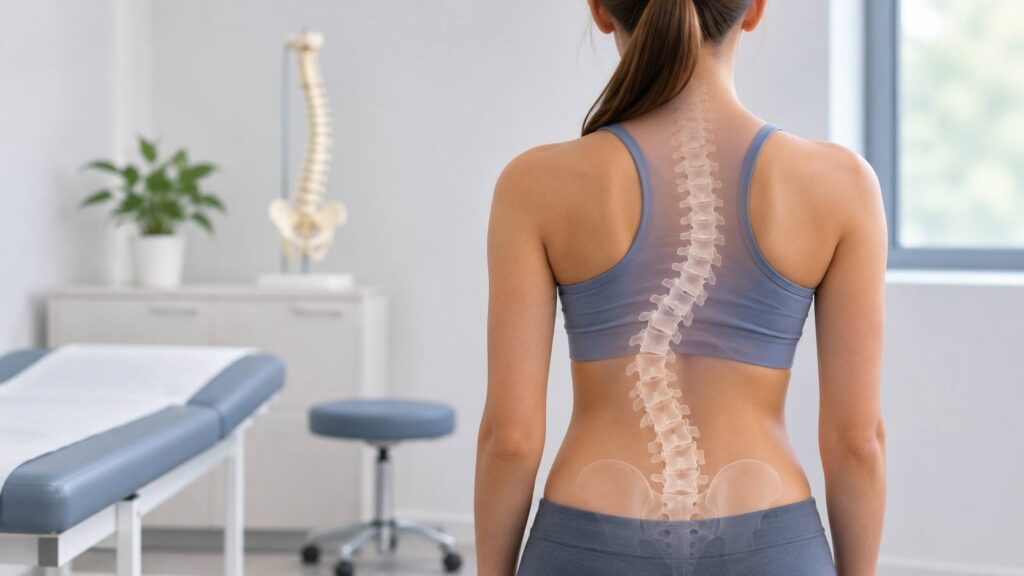


Does your lower back hurt after sitting at your desk? Do you experience sharp pain traveling down your leg or unexplained tingling in your fingers? While several spinal conditions can cause these symptoms, a bulging disc may be one possible explanation.
What does a bulging disc feel like? A bulging disc may cause a dull ache, sharp or burning pain, stiffness, tingling, numbness, or muscle weakness. When it irritates a nearby nerve, pain may travel from the lower back into the leg or from the neck into the shoulder, arm, and hand. However, some bulging discs cause no symptoms at all.
Understanding how disc-related pain develops, what makes it worse, and when to seek professional care can help you make better decisions about your spinal health.
This guide explains bulging disc symptoms, common causes, healing time, nonsurgical treatment options, and how chiropractic care may help.
What Is a Bulging Disc?
A bulging disc occurs when a spinal disc extends beyond its usual boundary. These discs sit between the bones of your spine, helping absorb pressure and allowing your back and neck to move.
Each spinal disc has two main parts:
-
Annulus fibrosus: A tough outer layer that provides strength and support.
-
Nucleus pulposus: A soft, gel-like center that helps absorb pressure.
As discs age or undergo structural changes, they may gradually widen beyond their normal edges. This is known as disc bulging.
A bulging disc does not always cause pain. Symptoms may develop when changes in the disc irritate surrounding tissues, narrow the space available for nerves, or contribute to nerve compression.
A 2015 systematic review published in the American Journal of Neuroradiology estimated that disc bulges were present in 30% of symptom-free 20-year-olds and 84% of symptom-free 80-year-olds.
These findings highlight why an MRI showing a bulging disc does not necessarily identify the cause of your pain.
What Does a Bulging Disc Feel Like?
Bulging disc symptoms depend on the disc’s location, the surrounding tissues, and whether nearby nerves are affected. Some people experience occasional discomfort, while others struggle with everyday movements.
Common Bulging Disc Symptoms
|
Symptom |
What It May Feel Like |
|
Dull pain |
A deep, persistent ache in the back or neck |
|
Sharp pain |
Sudden discomfort during certain movements |
|
Burning pain |
A hot sensation traveling into an arm or leg |
|
Radiating pain |
Pain spreading away from the affected spinal area |
|
Tingling |
A pins-and-needles sensation in the hands or feet |
|
Numbness |
Reduced sensation in certain body parts |
|
Muscle weakness |
Difficulty gripping objects, lifting, or walking |
|
Stiffness |
Restricted movement when bending or turning |
|
Muscle spasms |
Sudden tightening of muscles around the spine |
Nerve-related symptoms may extend well beyond the affected disc. For example, a problem in your lower back may cause discomfort in your calf or foot rather than directly around your spine.
What Does Bulging Disc Pain Feel Like During Daily Activities?
Certain movements and positions may make disc-related symptoms more noticeable.
You may experience discomfort when:
-
Sitting at a desk for long periods.
-
Driving for several hours.
-
Bending forward to put on your shoes.
-
Lifting groceries or heavy objects.
-
Coughing or sneezing.
-
Turning your head.
-
Getting out of bed or standing up from a chair.
These symptoms can also occur with other musculoskeletal conditions, so they cannot confirm a bulging disc on their own.
Signs of a Bulging Disc in Different Areas of the Spine
Disc-related symptoms vary depending on which part of your spine is affected.
Cervical Bulging Disc (Neck)
A bulging disc in the cervical spine may irritate nerves that travel into the shoulders, arms, and hands.
Common symptoms include:
-
Neck pain and stiffness.
-
Pain near the shoulder blade.
-
Burning or shooting arm pain.
-
Tingling or numbness in the fingers.
-
Reduced grip strength.
Thoracic Bulging Disc (Mid-Back)
Disc problems in the middle portion of the spine are less common than those in the neck or lower back.
Possible symptoms include:
-
Persistent mid-back discomfort.
-
Pain wrapping around the ribs.
-
Altered sensation around the chest or abdomen.
-
Difficulty with certain twisting movements.
New or unexplained chest pain should receive urgent medical assessment rather than being assumed to come from a spinal disc.
Lumbar Bulging Disc (Lower Back)
A lumbar disc bulge may affect nerves that travel from the lower spine into the legs.
Possible symptoms include:
-
Lower back pain.
-
Buttock discomfort.
-
Shooting pain down one leg.
-
Tingling in the calf or foot.
-
Leg weakness or difficulty walking.
When a lumbar disc irritates a nerve involved in sciatica, discomfort may travel from the lower back or buttock down the leg.
Bulging disc symptom locations
Illustrative symptom patterns. The exact location varies according to the nerves and tissues involved.
Can You Feel a Bulging Disc With Your Hand?
No, you cannot directly feel a bulging disc by touching your back or neck. Spinal discs sit deep within the spine, surrounded by bones, muscles, ligaments, and other tissues.
However, you may notice tenderness, tight muscles, or sensitive areas near the affected region.
A visible or noticeable lump under your skin should not automatically be considered a bulging disc. It may have another cause that requires examination.
A professional assessment is the appropriate way to investigate suspected disc problems.
What Causes a Bulging Disc?
A bulging disc commonly develops as part of gradual changes in the spine. Over time, spinal discs may lose moisture and become less flexible.
Several factors may contribute to disc changes or increase the risk of associated symptoms.
Common Causes and Risk Factors
-
Natural aging: Discs gradually lose water content and elasticity.
-
Repetitive physical strain: Frequent lifting, bending, and twisting can place stress on the spine.
-
Physical injuries: Falls, sports injuries, and car accidents may contribute to disc damage.
-
Genetics: Inherited factors may influence how early disc degeneration develops.
-
Smoking: Tobacco use is associated with spinal disc degeneration.
-
Excess body weight: Additional weight may increase the physical demands placed on the lower back.
-
Prolonged sitting: Remaining in one position for extended periods may aggravate existing symptoms.
A bulging disc is not necessarily the result of poor posture or a single incorrect movement. Several biological and physical factors may be involved.
Bulging Disc vs. Herniated Disc: What Is the Difference?
Although people often use these terms interchangeably, a bulging disc and a herniated disc describe different structural changes.
A bulging disc extends outward across a relatively broad portion of its edge. A herniated disc involves a more localized displacement of disc material beyond its normal boundary.
|
Feature |
Bulging Disc |
Herniated Disc |
|
Disc shape |
Broad outward extension |
More localized displacement |
|
Development |
Often associated with gradual changes |
May develop gradually or following injury |
|
Pain |
May be painless or symptomatic |
May be painless or symptomatic |
|
Nerve involvement |
Possible |
Possible |
|
Common symptoms |
Back pain, stiffness, or radiating discomfort |
Back pain, numbness, or radiating discomfort |
|
Initial treatment |
Conservative care when appropriate |
Conservative care when appropriate |
A herniated disc is not automatically more painful than a bulging disc. The location of the disc change and its effect on surrounding nerves often matter more than the name given to the condition.
A bulging disc also does not inevitably progress into a herniated disc.
How Is a Bulging Disc Diagnosed?
Because disc-related symptoms can resemble muscle strains, arthritis, spinal stenosis, and other conditions, diagnosis begins with a detailed evaluation.
Physical and Neurological Examination
A healthcare provider may assess:
-
Your medical history and symptoms.
-
Spinal movement and flexibility.
-
Muscle strength and reflexes.
-
Changes in sensation.
-
Walking patterns and balance.
-
Movements that increase or reduce discomfort.
Diagnostic Imaging
An MRI can provide detailed images of spinal discs, nerves, and surrounding soft tissues.
Spinal X-rays may help identify fractures, bone changes, or other structural concerns, but they cannot directly confirm a bulging disc.
Not everyone with back or neck pain needs an MRI. Imaging may be appropriate when symptoms persist, neurological problems develop, or the results could change the treatment plan.
Can a Bulging Disc Heal?
Yes, symptoms associated with a bulging disc can improve significantly, often without surgery. However, symptom recovery does not always mean the disc has returned to its original shape.
As irritation decreases and physical function improves, you may experience less pain and better mobility even if the disc remains visible on an MRI.
Recovery may involve:
-
Reduced irritation around spinal nerves.
-
Improved movement and flexibility.
-
Better muscle strength and physical function.
-
Increased tolerance for everyday activities.
The main goal of treatment is to help you function comfortably and safely rather than simply changing the appearance of your spine on an imaging test.
How Long Does a Bulging Disc Take to Heal?
Bulging disc symptoms may begin improving within a few weeks. Some people recover over several weeks, while others experience symptoms that continue for months.
There is no universal healing timeline because the severity and cause of symptoms differ between individuals.
Recovery period |
What You May Experience |
|
First few weeks |
Pain may gradually decrease, and movement may become easier. |
|
Following weeks |
Daily activities may become more manageable as symptoms settle. |
|
Several months |
Persistent nerve-related symptoms may require further evaluation or treatment. |
These are general recovery patterns, not guaranteed healing deadlines.
Factors that may influence recovery include your overall health, physical activity, underlying spinal conditions, nerve involvement, and the demands of your job.
If symptoms are worsening rather than improving, do not wait for a particular recovery deadline before seeking care.
Bulging Disc Treatment: How to Fix a Bulging Disc Without Surgery
Bulging disc treatment focuses on reducing discomfort, improving movement, managing nerve-related symptoms, and helping patients return to their normal activities.
Many patients can manage their symptoms with nonsurgical treatment.
1. Stay Physically Active
Gentle movement can help maintain flexibility and prevent stiffness. Short walks and comfortable daily activities are generally better than extended bed rest.
Avoid movements that significantly increase pain, numbness, or weakness.
2. Therapeutic Exercises
A personalized exercise program may help improve spinal mobility, strengthen supporting muscles, and restore physical function.
Exercises should be selected according to your symptoms rather than following a general online routine that may not suit your condition.
3. Chiropractic Care
Chiropractic care may help selected patients manage spinal discomfort and improve joint movement. Treatment should be adapted to the location of the disc problem and the patient’s neurological findings.
4. Heat and Cold Therapy
A warm compress may help relax tight muscles, while a cold pack may provide temporary pain relief during a flare-up.
Neither method directly repairs a bulging disc, but both may help manage discomfort.
5. Massage and Soft Tissue Therapy
Massage therapy, myofascial release, and other soft tissue techniques may help manage associated muscle tension and improve comfort.
These treatments address surrounding muscles rather than physically repositioning the disc.
6. Medication and Medical Treatment
A medical provider may recommend pain-relieving or anti-inflammatory medications when appropriate. Patients with persistent or severe nerve-related pain may require additional medical treatment, such as an epidural injection.
Surgery may be considered when significant nerve compression, progressive weakness, or disabling symptoms require specialist intervention.
Can a Chiropractor Help With a Bulging Disc?
Yes, chiropractic care may help patients with bulging disc-related discomfort, particularly when symptoms involve restricted movement, back pain, or surrounding muscle tension.
However, chiropractic adjustments cannot physically push a bulging disc back into place or guarantee structural healing.
A chiropractor should first determine whether conservative treatment is appropriate or whether further medical evaluation is necessary.
Chiropractic Treatments That May Help
Depending on your examination findings, chiropractic treatment may include:
Chiropractic treatment |
Potential purpose |
|
Chiropractic adjustments |
Improve joint movement and manage selected types of spinal pain |
|
Active Release Technique |
Address associated soft tissue tightness |
|
Myofascial release |
Manage muscle and connective tissue tension |
|
Massage therapy |
Reduce muscular discomfort |
|
Physiotherapy exercises |
Improve strength, movement, and physical function |
|
Trigger point therapy |
Address localized muscle tenderness |
|
Movement and posture guidance |
Help manage activities that aggravate symptoms |
Research supports spinal manipulation as an option for certain types of lower back pain. However, evidence specifically demonstrating that manipulation heals bulging discs remains limited.
Temporary soreness may occur following treatment. Serious complications are rare, but neck manipulation has been associated with rare vascular injuries. Patients should discuss the risks, benefits, and available alternatives before treatment.
Chiropractic care is not appropriate for every disc condition, particularly when serious neurological symptoms are present.
Does Spinal Decompression Help With a Bulging Disc?
Yes, Nonsurgical spinal decompression is a form of mechanical traction that applies a controlled stretching force to the spine. Its intended purpose is to temporarily reduce spinal loading and manage certain symptoms.
Although some patients report improvement, research has not consistently demonstrated that spinal decompression provides meaningful additional benefits over other conservative treatments.
There is also insufficient evidence that spinal decompression permanently restores disc height or reverses disc bulging.
Intersegmental traction is another technique that uses controlled movement to support spinal mobility. It is different from computer-controlled spinal decompression.
Neither treatment should replace a proper examination, appropriate exercise, or necessary medical care.
When Should You Seek Medical Attention for a Bulging Disc?
Not every episode of back or neck pain requires emergency treatment. However, certain symptoms may indicate significant nerve or spinal cord compression.
When to See a Chiropractor
Consider scheduling an evaluation if you experience:
-
Recurring back or neck discomfort.
-
Persistent stiffness that limits movement.
-
Pain during normal daily activities.
-
Mild radiating discomfort that is not worsening.
-
Back pain that interferes with work, exercise, or sleep.
New numbness or muscle weakness requires prompt clinical assessment before starting routine chiropractic treatment.
When to Seek Emergency Medical Care
Seek immediate medical attention if you experience:
-
Sudden loss of bladder or bowel control.
-
New difficulty urinating.
-
Numbness around the groin, genitals, or inner thighs.
-
Severe or rapidly worsening muscle weakness.
-
Sudden difficulty walking or maintaining balance.
-
Severe spinal pain following a major accident.
Some of these symptoms may indicate cauda equina syndrome or spinal cord compression, which require urgent medical treatment.
Back pain accompanied by fever, unexplained weight loss, or a history of cancer also requires prompt medical evaluation.
How to Reduce the Risk of Future Disc Pain
Although age-related disc changes cannot always be prevented, healthy movement habits may help manage spinal discomfort and reduce future symptom flare-ups.
-
Take regular movement breaks during desk work.
-
Keep heavy objects close to your body when lifting.
-
Avoid sudden twisting while carrying heavy loads.
-
Maintain a comfortable and supportive workstation.
-
Build muscle strength through appropriate exercises.
-
Stay physically active within your abilities.
-
Maintain a healthy body weight.
-
Avoid smoking.
-
Return to demanding physical activities gradually after an injury.
You do not need to maintain one perfect posture throughout the day. Changing positions regularly and staying comfortably active may be more useful than trying to sit or stand rigidly.
Chiropractic Care for Bulging Disc Symptoms in Charlotte, NC
Living with persistent back pain, neck discomfort, or radiating pain can make everyday activities challenging. Understanding the underlying cause is an important first step toward finding suitable care.
At Chiropractic Fitness in Charlotte, NC, Dr. Craig Schulman provides personalized chiropractic care for patients experiencing spinal discomfort, restricted mobility, sports-related injuries, and other musculoskeletal concerns.
Depending on your condition and examination findings, available services include:
Treatment recommendations depend on your symptoms, medical history, examination results, and individual needs.
If you are experiencing persistent back pain, neck stiffness, or suspected bulging disc symptoms, schedule an appointment with Dr. Craig Schulman at Chiropractic Fitness in Charlotte, NC, to discuss your symptoms and appropriate care options.
Address: Charlotte, NC
Website: Chiropractor in Charlotte, NC
Phone: (704) 543-7206
Map: Chiropractic Fitness – Charlotte, NC
Conclusion
So, what does a bulging disc feel like? It may cause a dull ache, burning pain, stiffness, or discomfort that travels into your arms or legs. Some disc bulges cause no noticeable symptoms, making an accurate diagnosis important.
Many patients improve with conservative treatment, therapeutic exercises, and changes to daily activities. Chiropractic care may also help manage disc-related discomfort and improve spinal mobility.
If you are experiencing persistent back pain, neck pain, or bulging disc symptoms, Chiropractic Fitness in Charlotte, NC, can help you explore appropriate treatment options based on your individual needs.
Book your appointment with Dr. Craig Schulman today and take the next step toward better spinal health and improved mobility.
About the Author
Dr. Craig Schulman’s interest in chiropractic care began through his personal experiences managing neck pain, lower back discomfort, and headaches while playing football.
He began studying at Life University in 1998, completing coursework in anatomy, biochemistry, physics, X-ray interpretation, and chiropractic techniques before earning his Doctor of Chiropractic degree.
His additional professional training includes injury triage, trauma care, head trauma, and brain injury. His qualifications include Board-Certified Chiropractic Sports Physician®, Active Release Therapy® certification, and Kinesio Tape® certification.
At Chiropractic Fitness in Charlotte, NC, Dr. Schulman focuses on personalized chiropractic care for patients with back and neck discomfort, sports-related injuries, and other musculoskeletal concerns.
Frequently Asked Questions
Can a Bulging Disc Heal on Its Own?
Yes. Many people experience improvement without surgery as irritation settles and physical function returns. However, the disc may remain visible on an MRI even after symptoms improve.
What Makes Bulging Disc Pain Worse?
Prolonged sitting, repetitive bending, heavy lifting, twisting, and coughing may aggravate symptoms. Triggers vary between patients, so it is important to understand which movements affect your condition.
Is Walking Good for a Bulging Disc?
Walking may help maintain mobility and reduce stiffness. Start with short, comfortable walks and gradually increase your activity as tolerated. Stop and seek advice if walking increases neurological symptoms.
Can a Bulging Disc Cause Sciatica?
Yes. A bulging disc in the lower back may contribute to sciatica when it irritates or compresses a nerve root associated with the sciatic nerve. Symptoms can include leg pain, burning sensations, tingling, and numbness.
Can a Chiropractor Fix a Bulging Disc?
A chiropractor may help manage associated pain, muscle tension, and restricted movement. However, chiropractic treatment cannot guarantee that a bulging disc will return to its original shape. Care should focus on improving symptoms and function.
Does a Bulging Disc Always Require Surgery?
No. Nonsurgical care is often appropriate when serious neurological symptoms are absent. Surgery may be necessary when significant nerve compression causes progressive weakness, emergency symptoms, or persistent disabling pain.